The United States, Canada and Mexico are heading into the sixth round of talks on NAFTA in mid-January 2018, and on December 11th, The Consulate General of Canada in New York, together with Canada’s Trade Commissioner in Philadelphia, Vince Finn, held a roundtable discussion and luncheon to discuss the “Modernization of NAFTA.” Over 50 business people gathered at Duane Morris to hear the Honourable Perrin Beatty, President and CEO, of the Canadian Chamber of Commerce, talk about the opportunities and challenges of NAFTA in an interview led by Ram Mudambi, Professor of Strategy for Temple University’s Fox School of Business.
Mr. Beatty commented on Canada’s commitment to build a stronger relationship with the United States and make trading easier. He also talked about working together to strengthen the Canadian border – the largest land border in the world.
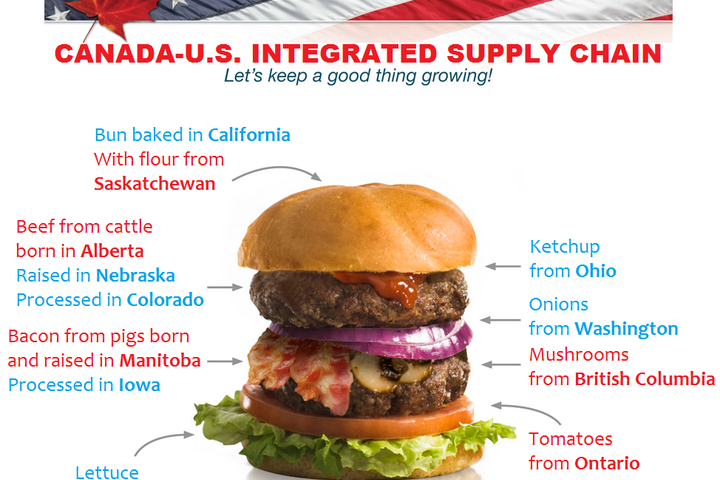
The photo of the burger (pictured) summarizes the integrated supply chain between Canada and the U.S. – and that is just this burger.
Canada and the United States have been long trading partners - $1.2 million in bilateral goods and services every minute of every day! Some more statistics:
• In 2016, total goods and services traded between Canada and the United States totaled nearly $635.1 billion.
• Canada is Pennsylvania’s number one customer, with 346,000 jobs in Pennsylvania dependent on trade and investment with Canada.
• Annually, Pennsylvania exports $9.9 billion in goods to Canada
• Pennsylvania sells more goods to Canada than to its next four largest foreign markets combined
• Annually, Pennsylvania imports $10 billion in goods from Canada
“Why are their different standards in Canada and the US for a can of soup?” Mr. Beatty asked. If you want to sell a can of soup each country requires a certain amount of salt, and the size of the can is different. The extra manufacturing costs aren’t necessary.”
Mr. Beatty ended the interview with a reference to the protectionist measures of the Smoot-Hawley Tariff Act (sponsored by Senator Reed Smoot and Representative Willis C. Hawley), which was passed by the US Congress in 1930. The tariff, an attempt to help protect domestic farmers and other US businesses against stepped-up imports after World War I, has been said to have prolonged the dire international economic climate of the Great Depression.
“We run the risk that in January; we could destroy the most successful relationship between two countries”
Phyllis Yaffe, Canada’s Consul General in New York added:
“Canada is fully committed to these negotiations and will continue to engage constructively in order to develop mutually-beneficial approaches to improving the agreement. We are concerned with a number of U.S. proposals, which are deeply counter-productive, and would only serve to roll back the benefits provided by NAFTA. Canada’s approach is focused on making a good agreement even better, and making updates that improve NAFTA’s alignment to new realities in trade and investment. We count on political and business leaders across Pennsylvania to make clear to the Administration that American families, businesses, and communities have much to gain from open and balanced trade, and much to lose if our negotiations are unsuccessful. Nothing less than our joint prosperity is at stake."
Following the meeting, Vincent Finn offered the following information:
• Canada has engaged constructively throughout the NAFTA renegotiations. From the very beginning at Round One, we delivered prepared text for all areas, which we had promised, including a comprehensive proposal on improving the ISDS system.
• The unconventional US proposals are not supported by US industry and stakeholders, and will not help the negotiations move towards the ‘win-win-win’ outcome that VP Pence alluded to in July during the National Governors’ Association meeting in Rhode Island.
• Canada will continue to be flexible during the negotiations and look for solutions that spur job creation and growth of the middle class in the US, Canada and Mexico.
Background on specific clauses:
• A sunset clause: This would create an unstable business environment and hamper foreign investment in North America. NAFTA has provided a stable framework for businesses and investors in North America, and this needs to be maintained.
• Rules of origin for the automotive sector: The U.S. auto proposal would require a regional value content requirement of 85%, a 50% U.S. content requirement and tracing of all inputs. The proposal is wholly unworkable and would not only be damaging to the Canadian and Mexican auto sectors, but to the U.S. auto sector as well. North American supply chains supporting the production of North American cars are deeply integrated and highly efficient, making the North American cars we build together competitive. Auto manufacturers in the United States (as well as Mexico and Canada) have been adamant that the existing NAFTA is working and that modernizing the agreement should be done with a view to doing no harm.
• On trade remedies and dispute settlement: Effective, transparent, and enforceable dispute settlement provisions are a critical part of any free trade agreement, and they have been essential to the success of NAFTA. Dispute settlement mechanisms under NAFTA, including the binational panels for anti-dumping and countervailing duties, have proven to be beneficial to all three NAFTA parties since its inception in 1994.
• Government procurement: The U.S. has tabled a “dollar-for–dollar” proposal, which would virtually eliminate Canadian access to the U.S. procurement market under NAFTA. Canada and the U.S. are each other’s largest trading partners. Our view is that we should approach this negotiation with the aim of giving each other the best access possible to our respective government procurement markets.
Linda Conlin, President of WTCGP stated, “The WTCGP was pleased to partner with the Consulate General of Canada in NY to organize Canadian Chamber President Perrin Beatty’s discussion with our business community. Recently, I had the opportunity to speak with other members of the North American World Trade Centers where we were briefed by the US Chamber of Commerce on their efforts to advocate for a successful modernization of the NAFTA agreement. Together with our fellow world trade centers, we support progress on this important trilateral agreement and applaud all efforts to expand worldwide the growth of economic opportunity and prosperity through trade.”