Before the COVID-19 pandemic hit, Annie International’s website showed a beautiful model wearing lipstick, now the model wears a mask.
For the past 27 years, Annie International, with headquarters in North Wales, PA, has serviced the beauty industry providing hair, skin, nail and makeup products to 49 countries.
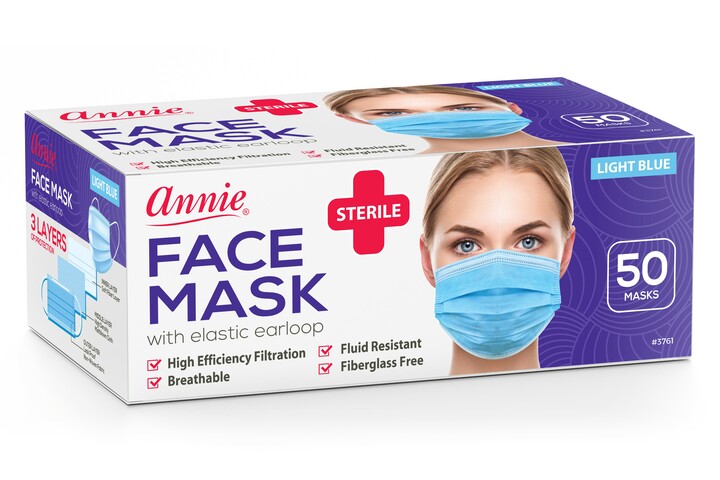
In mid-March, when the United States was in the early weeks of the global pandemic, Annie knew it was time to switch production of their Personal Protection Equipment (PPE), primarily used by salon workers, to include surgical and medical grade products – especially masks.
Annie created an official division – Annie Medical PPE
But it wasn’t easy.
Steven Miller, Executive Director of Sales and Operations explained the challenging process, “There were countless obstacles that we faced through the whole process. COVID-19 really showcased how unprepared the world is when it comes to each country being able to sustain itself with essential products.”
Quality of Product
“The first obstacle was securing quality production. Many factories, brokers and resellers were and still are marketing imposter products using fake certifications and test results. We have representatives from Annie International on the ground in China verifying product, cutting open masks, and then the Quality Control process happens again here in America. When it comes to face masks the key ingredient is a filtration material called meltblown. This textile became a major commodity. Having true meltblown and at the right thickness (grams) in each mask is essential.”
Testing to meet National Institute for Occupational Safety and Health (NIOSH) Standards
“We had to start the long process and invest 10s of thousands of dollars to have our products tested at Nelson Labs, a globally recognized lab. Many of our products have FDA, CE and ISO certifications among others but we quickly learned that many doctors and insurance companies require NIOSH certification, formed by the CDC. When the world is in crisis and needs immediate PPE there should be a process to streamline this testing. In the meantime doctors, nurses and other healthcare workers had to resort to not wearing PPE, wearing the same PPE or wearing a homemade PPE, while we have medical and surgical grade PPE’s ready and willing to donate and/or sell.
Obtaining KN95 Approval in USA
“The standard in the US is the N95 mask. The N95 is made in America, the KN95 is made in China and the KF94 is made in Korea. These three masks are the most common and widely used medical grade masks in the world. Because N95 masks were not readily available in America the last two options were the KF94 and KN95. Fortunately China still allowed KN95 masks and surgical masks to be exported to other countries, and they soon were allowed in America. Japan, Australia, Mexico, UK, Europe and America all started immediately getting supplies from China as there was/is no other source.”
Supply Chain Production Availability
“Many countries closed their borders for exporting and American manufacturers were not permitted to export PPE out of the country. The problem is most countries did not have a large enough stock pile nor did they have large enough manufacturing capabilities to keep up with the demand. China was the one country remaining open to export PPE but that supply chain was fluid daily and sometimes changed by the hour. Our only option to keep our supply chain at Annie International going was through our partnership with our factories in China.”
Labeling & Package Requirements and Certifications
“Laws, required certifications, and labeling & packaging requirements changed daily and weekly in some cases. We had to repackage a shipment that went through customs at the airport and was ready to leave, due to packaging/labeling requirements that changed.”
Customs Delays
“Shipments were being held in customs for long lengths of times due to the extreme high volume of PPE and because of changing regulations.”
Missing Product from Shipment
“When dealing with a healthcare system, national chain store, major distributor or union this shortage can be dealt with. When dealing with a government contract this shortage is an issue when you come up short.”
High Demand, High Freight Costs, Not enough Planes
“Standard air freight went from around $2/KG up to $26/KG. This is outrageous.
The main freight carriers such as DHL, UPS and FedEx would only accept shipments up to a certain weight. Large shipments had to rely on airlines, which either stopped flying into and/or carrying freight from China. As the airlines dropped off one by one over the weeks companies were fighting for space on planes, driving up cost. At one point Amazon, being the largest airline customers, took all of the flights out of China for 1-3 weeks while our product sat waiting.”
Cash Up Front
“Ten to twenty year relationships with factories didn’t matter. If you have/had terms with a factory those terms were not applicable when it came to PPE. The global supply chain for PPE’s became and still is cash based market. You must wire 50% of the cash at time of placing a PO and then the remaining 50% at completion of production before shipment. Some factories were requiring 100% upfront before production. Large National Retailers, Governments and militaries from countries all around the world, and major medical systems are and were not prepared.
Despite the challenges, Annie Medical PPE division currently provides 4.5 million + masks to the world – weekly. A portion of every shipment sold is donated to local grocery stores, police departments, township employees and healthcare workers throughout Pennsylvania.
While the United States maintains PPE export restrictions, Annie has been able to use its distribution centers around the world and leverage established relationships in 49 countries to direct ship PPE to its international customers.
“We have been providing the Mexican Government in Mexico City with millions of masks per shipment to support their healthcare system due to COVID-19. The Mexican Government had to also meet the new “playing rules” and wire the money in advance before receiving the product.
When the product arrived police and military escort then took it to the social security procurement. We have done this with many countries such as Jamaica, Dominican Republic, South Africa, UK, and France.”
“We have always been in the business of PPE products, just not to the level of what the country and world needs now,” Miller emphasized.
And while Miller calls the global PPE market “the wild wild west,” he admits the challenges are worth it to save lives.