It was about 20 years ago that Tom Clark, head of the Metro Denver Economic Development Corp., recalls running around town saying Denver could compete on the international business scene with cities like Austin and Portland.
After he left the room, the crowds just howled with laughter, Clark found out years later.
Now, Clark and people like Karen Gerwitz, president of the World Trade Center Denver, developer Sean Campbell and Mayor Michael Hancock are saying Denver is on the cusp of becoming a global city, competing with the likes of London and Singapore.
This time no one appears to be laughing — even after they’ve left the room.
“The timing is right and we have to be aspirational about it and be ahead of it,” said Pam Reichert, vice president of the Metro Denver EDC and co-chair of Hancock’s International Advisory Council.
In September, the city revealed an international strategy that includes beefing up exports, creating a manufacturing park and economic incentive zones to attract foreign direct investments, and integrating immigrant and ethnic business owners into the business community.
A lot can happen in 20 years, Clark said. Consider what is already in motion:
- An expanded network of air routes from Denver International Airport to Asia, Europe and Canada.
- Plans for extensive development of new business at and around DIA, aiming to attract companies and foreign direct investment.
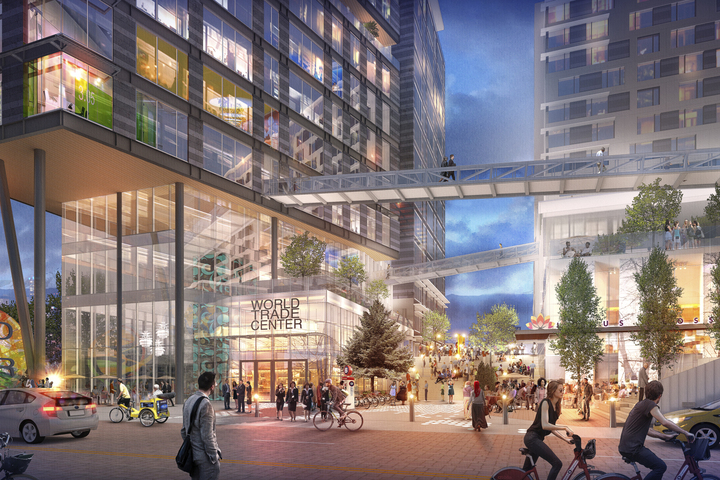
- And a proposed World Trade Center campus that includes a 200-room hotel, 200,000 square feet of office space and a 40,000-square-foot conference center with a sole mission of international trade.
“This is the beginning of where we see ourselves,” Clark said.
Why now?
In the 1980s, when the city had a lot of its economic eggs in the oil and gas basket, some areas of the city had 70 percent vacancy rates and LoDo was just getting started.
Then-Mayor Federico Peña worked to diversify the economy, pushing the construction of a new airport and convention center. That work was followed by subsequent mayors who worked to build on the city’s arts assets, parks and infrastructure.
Then the city started to compete again as a place for business expansion, foreign investment and growth. Today, with a population of 2.6 million, it’s the 21st largest metro area in the country and has the 18th largest gross metropolitan product (GMP), the toatl value of the goods and services it produces.
In 2015, foreign direct investment in commercial real estate alone was $980.5 million, or 9 percent of the total commercial real estate investment in metro Denver. And foreign-owned companies have created 85,000 jobs — about 3 percent of the total workforce.
“On the heels of the Great Recession, if that recession has taught us anything, it’s that we live in a global marketplace,” Hancock said. “My goal and objective is to make Denver a globally connected city. We must open the door to businesses around the world.”
In 2011, Denver hosted the Global Cities Forum, which featured Denver as one of 42 cities with the greatest potential to be “globally fluent” — a city with global understanding, competence, practice and reach. And that’s when attitudes shifted, said Reichert.
“It started to make the business community think,” she said.
Still, when analyzed as a globally fluent city, Denver was considered only in the middle of the pack of a three-tiered ranking system by the Globalization and Work Rankings Research Institution.
The city was considered on par with cities like San Jose, Minneapolis, Abu Dhabi and Edinburgh, and was said to be instrumental in linking its region or state to the world’s economy. Cities in the top tier include New York, Los Angeles and Chicago in the U.S., along with Hong Kong, London, Paris, Singapore and Dubai overseas.
Then, in 2013, the Brookings Institution described Denver as hitting above its rank, said Paul Washington, the city’s economic development executive director.
Denver, the Brookings analysis said, put in place some of the ingredients of a global fluent city including its Denver International Airport. But it fell short in areas of exporting and the integration of immigrants into its business community — other key traits of successful global cities.
“At only 7.2 percent of GMP, [Denver’s] export intensity is well below that of highly competitive and international metros,” the Brookings analysis said.
It seemed, Washington said, the city had to do two things – increase its exports and make a plan for how to integrate new immigrants, which includes developing business and cultural programs for new immigrants and ethnic populations.
“With global fluency, ... we are in between, but we have the potential to become globally fluent,” he said.
Making a plan
Last year, Hancock set up the International Advisory Council of local business leaders to write goals for an International Strategic Plan, which was completed in September. The idea was to move Denver into the top tier of cities on the global scene.
“The airport did its business, now we have to do ours,” said Reichert, with the Metro Denver EDC.
She believes the city does not have to grow to the size of Chicago, LA or New York. Instead, she said if the Denver zeros in on adding international flights, stays focused on its nine identified industry clusters, works to welcome and integrate immigrants, and builds momentum with existing trading partners including Japan, the city will become globally fluent.
“We are right there,” Reichert said. “We aren’t New York. We aren’t San Francisco or Los Angeles. We don’t need to be.”
Why Denver?
Arrow Electronics Inc. considered several locations in the United States for its new global headquarters in 2011. It has 460 locations in 85 countries. Arrow (NYSE: ARW), a Fortune 500 company and Colorado’s largest public company by revenue, said DIA was one of the key reasons it moved its global headquarters from Long Island, New York to suburban Centennial.
“I can tell you that 50 percent of our revenue comes from outside the U.S.,” said John Hourigan, Arrow global vice president of communications. “For us, access to those countries is a business imperative.”
DIA has 20 nonstop international destinations in eight countries.
Arrow’s main business is in electronics components supply and sales of large computing systems and data center equipment. So there was something else about Denver that was attractive: the educated workforce. But even if the educated workforce isn’t in Denver, Hourigan said, they are willing to come.
“People in other regions are very impressed with Denver,” he said. “Among the reasons we designated Colorado as our headquarters — business environment, transportation, but there is also a cultural environment. They see Denver as the total package.”
Washington said the city’s efforts in the coming year will be focused on manufacturing. In 2015, the city ran a pilot program where it teamed with Denver Beer Co. — maker of Graham Cracker Porter — to write an export plan and the target country was Japan.
The company recently began exporting to Japan and Washington says the exporting plan is something that can be duplicated with other manufacturers. The next partnership will be with a medical devices company, he said.
“The challenge for Colorado and Denver [is that] we are not at a port. So a lot of manufacturing will involve high value, low weight goods,” he said. “This is why medical devices are important.”
The city plans to open a manufacturing park in 2017, where many manufacturers can share facilities, research and development, storage and transportation. It also will designate economic zones for tax incentives in an effort to attract manufacturers.
But a key to becoming globally fluent may rest with immigrants, Washington said. The city is hoping to develop programs and services that help immigrant business owners.
“Anytime you think about a globally fluent city, these cities have identifiable concentrations of immigrant communities like Chinatown in San Francisco and Little Italy in New York.” The city will target South Federal and East Colfax — two areas with high concentrations of minority-owned businesses.
“The question is, how do we organize pockets of international culture that allows for immigrants to have business opportunities and entrepreneurial opportunities?” Washington said. “It offers real authenticity from a retail experience and it makes everyone that much more sophisticated and more exposed to other cultures and makes it more comfortable when they see the best of those cultures represented.”
Being a welcoming city is among the traits that Brookings used to define globally fluent cities.
“For me, my biggest ‘a-ha’ moment was that we do need to figure out how to more fully integrate our immigration population into the discussion and into the community,” Reichert said. “If we can do that, we would have the best marketing team ever. They go back and tell their friends and family and that will amplify us being a global city.”
World Trade Center campus
The planned World Trade Center campus in the River North neighborhood is more than just a cluster of buildings, said Campbell, CEO and founder of real estate company Formativ, the developer on the WTC campus project.
“(The) vision is to look at this campus as not just an opportunity to compete with Austin and Portland and Nashville, but to compete with Singapore and Munich and London,” he said.
“The amenities will play to the culture and community with a large public development for festivals, events, fundraisers and foreign movie night – and all those things you would want in a global community.”
Gerwitz, who heads up World Trade Center Denver, said the campus at 38th Avenue and Blake Street will be the first to use a campus model of mixing World Trade Center services, business headquarters, education, retail space and cultural events.
“But we will have one single focus and that is expanding global business,” she said.
The first phase of the new campus, which will take up about 1.5 acres, is a $200 million construction project on the rail line from Union Station to Denver International Airport. It’s expected to break ground next year and open in 2019.
(The WTC was downtown between Broadway and 16th Street for 29 years and now is temporarily located at Geotech at 2650 E. 40th Ave.)
“It’s going to be about expanding your business globally and that doesn’t mean only exports either,” Gerwitz said. “It means imports. It means investments and tech transfer across exporters. Trade is completely changing. Our model needs to change with it.”
“We are on the cusp of this major shift,” Gerwitz said.
Monica Mendoza covers banking and financial services, legal services, retail, the economy and economic development, and sports business. Phone: 303-803-9230.